

TSPU Presents Its Approach to Integrating AI into Teacher Mentoring at International Conference in Yaroslavl
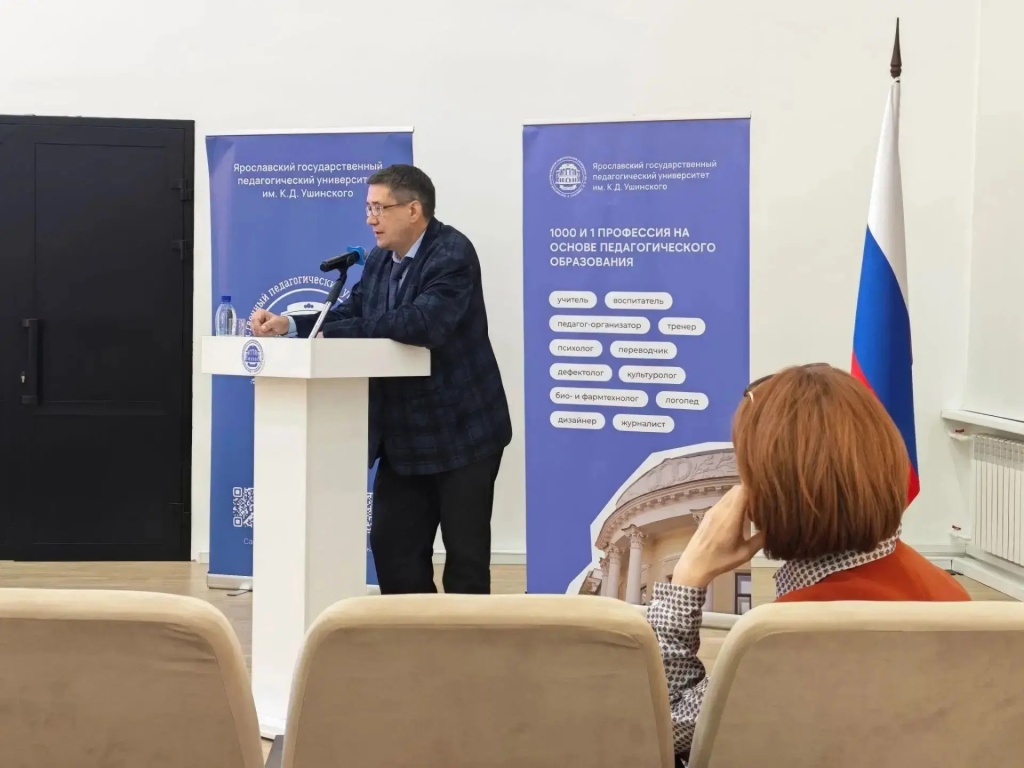
The 19th International Research and Practice Conference, Tutoring in Open Educational Environments: Human-Centred Practice in the Age of Artificial Intelligence, was held at Ushinsky Yaroslavl State Pedagogical University from 21 to 23 October 2026.
The presentation also covered the pilot testing of five prototypes at Eureka-Development School. The school’s experience helped identify the organisational and methodological conditions needed for successful implementation of AI tools: short, practical training sessions for teachers, ready-to-use activity plans, support from school management and regular evaluation of the results.
«We are deliberately moving away from an approach in which AI does the work for the student. Hybrid mentoring is about dividing responsibilities: the service takes care of routine analysis and navigation, while goal-setting, decision-making and accountability remain with the person», – Glukhov explained.
On 22 October, Chervonny spoke at the «AI as a Cognitive Partner» session, presenting a paper titled «How Generative AI Can Foster Critical Thinking in Teacher Mentoring». His central argument was that the value of generative AI lies not in the volume of text it produces, but in its ability to prompt students to ask questions, test hypotheses and justify their own decisions.
«The danger is not that a neural network will write an assignment for a student, but that the student will stop noticing where their own thinking ends and the AI’s suggestions begin. That is why, in our project, we design not only digital services but also learning situations in which AI prompts students to challenge ideas, question assumptions and provide evidence for their reasoning. If that does not happen, then no matter how advanced the tool may be, it works against the very purpose of mentoring», – Chervonny emphasised.
Then on 23 October followed a workshop held by the Tomsk researchers, titled «Defining the Boundaries of AI Assistance: The Co-Supervisor Service in Hybrid Mentoring». Participants worked with a functioning prototype developed at TSPU to support master’s students writing their final theses. The researchers also demonstrated a supervisor service that interprets digital traces of students’ learning activities and identifies signs of difficulties. The workshop placed particular emphasis on the human-centred dimension of the approach: preserving students’ authorship, encouraging reflection and maintaining a carefully managed balance between delegating tasks to AI and working independently. Participants discussed how responsibilities should be shared among students, academic supervisors and AI, how digital traces of learning can be used, and how the authorship of research work can be protected.
«The service should not be “smarter” than the student; it should be more precisely configured. During the workshop, we showed how a teacher can regulate the level of AI involvement: when a hint is enough, when a draft needs to be reviewed in detail, and when assistance must stop so that the work remains the student’s own. That is what pedagogical design for AI support is all about», – Chervonny concluded.
The key message of the presentations in Yaroslavl was that AI should neither replace teachers nor do students’ work for them. Its role is to extend the capabilities of mentors, help personalise learning pathways and provide more meaningful support, while leaving people responsible for educational decisions.
The conference gave TSPU an opportunity to present its developing models and digital tools to the professional community and identify priorities for further testing and scientific evaluation.
The results presented at the conference were obtained as part of the Russian Science Foundation project No. 26-18-00832, Fundamental Principles for Integrating Artificial Intelligence into Teacher Mentoring: Developing a Theoretical Model and Mechanisms for Personalising Learning Pathways (2026–2028). More information is available on the RSF project page.



29 October 2026


